VIVEK DHAKAL
Classification of Hydropower Plants | Types of Hydropower Projects

Classification of Hydropower Plants | Types of Hydropower Projects


Classification of Hydropower Plants

a) Based on Purpose

1. Single Purpose Project
It is solely designed for the purpose of hydroelectricity generation.
Eg: Upper Tamakoshi Hydropower Project
       Khimti Khola Hydropower Project

2. Multipurpose Project
It is designed to fulfill more than one function or objectives. For example, the water diverted for hydroelectricity generation may also be utilized for irrigation purpose.
Eg: Bheri Babai Diversion Multipurpose Project
      Sunkoshi Marin Diversion Multipurpose Project

b) Based on Operation

1. Isolated Plant
Micro and mini hydropower plants in rural areas may be designed to serve particular village only and is not connected to the national grid is called isloated plant.

2. Grid Connected Plant
Hydropower plant with a power station feeding to a grid is called grid connected plant.

c) Based on Head

According to Dandaker and Sharma, hydropower plants can be categorized based on head as below:
Low head plants: <15m
Medium head plants: 15 - 70m
High head plants: 71 - 250m
Very high head plants: >250m

In case of Nepal, the following classification can be adopted:
Very high head plant: >350m
High head plant: 150 - 350m
Medium head plant: 60 - 150m
Low head plant: Below 60m
Very low head plant: Upto 15m

d) Based on Plant Capacity

As per Dandaker and Sharma, hydropower plants can be categorized based on capacity as below:
Micro hydel plants: <5 MW
Medium capacity plants: 5 - 100 MW
High capacity plants: 101 - 1000 MW
Super plants: >1000 MW

In case of Nepal, the following classification can be adopted:
Micro plants: upto 100 KW
Mini plants: 100 - 1000 KW
Small plants: 1 - 25 MW
Medium plants: 25 - 100 MW
Large plants: >100 MW

e) Based on Storage Capacity

1. Run of River (ROR) Project 
Those plants which do not regulate the hydrograph of source river in seasonal term, are known as ROR plants. Such plants are located in perennial river. Weir is constructed across the river to maintain the required water level u/s of weir and water is diverted into a waterway. It may have following three possible layouts:
  • ROR project with canal system
  • ROR project with pipe option
  • ROR project with tunnel option
Keeping the considerations during peak hours, ROR plants may be constructed with pondage, which can regulate daily hydrograph or weekly hydrograph and store water (full or partial) to run the plant under full capacity is called PROR plant.
General Layout of ROR type hydropower project
 Fig: General Layout of ROR type hydropower project

2. Storage Project
Those plants which can regulate the hydrograph of river by one or more seasons, are usually known as storage plants. Such plants are located in non-perennial rivers. A dam is constructed across the river that creates a large reservoir in front of it. It may be of following types:
  • Storage project with powerhouse at dam toe
  • Storage project with powerhouse at certain distance d/s of dam
The storage project may be of seasonal storage, annual storage, and pumped storage based on regulation of water. Pumped storage plants use excess electricity during periods of low demand to pump water from a lower reservoir to an upper reservoir. Then, during periods of high electricity demand, the stored water is released from the upper reservoir to the lower reservoir, generating electricity in the process.
What is Cavitation & its Effects in Turbine ?

What is Cavitation & its Effects in Turbine ?

What is Cavitation ?

Cavitation is a phenomenon that arises when the pressure of a liquid drops below its vapor pressure, causing the formation of vapor bubbles or cavities. Pressure drop may occur in the region of high flow velocities, for eg. at the exit of turbine runner. As the water flows through the turbine, its velocity increases. And according to Bernoulli's principle, an increase in flow velocity causes increase in velocity head and hence decrease in  pressure head since the total head always remains constant.

What Causes Cavitation in Turbine ?

When prevailing pressure falls towards vapour pressure of liquid, water starts vaporising and at the same time, normally dissolved gas gets liberated due to low ambient pressure. The water vapour and the liberated gas thus forms minute microscopic bubbles in the flowing water. When these bubbles get transported to the zone of higher pressure which is high enough to overcome the surface tension of bubbles, they get collapsed. When millions of such bubbles collapse simultaneously, a shock wave similar to water hammer but of short duration is produced which slowly causes erosion of concrete and metal surfaces.

What are Harmful Effects of Cavitation in Turbine ?

  • Erosion of concrete and metal surfaces.
  • Vibration and noise of machine parts
  • Loss of material due to pitting
  • Reducing the actual volume of liquid due to formation of bubbles

How to avoid Cavitation in Turbine ?

  • A careful streamlined design of flow passage of the runner and draft tube.
  • The sub atmospheric pressure at runner exit should be kept resonably above the vapour pressure limit.
  • By using metals more resistance to cavitation damage.
  • By periodic inspection and maintenance of turbine.
Working Principle & Functions of Draft Tube in Turbine

Working Principle & Functions of Draft Tube in Turbine

Draft tube is a pipe of gradually increasing cross-section that connects the outlet of turbine runner to the tailrace. It is used for discharging the water from exit of a reaction turbine to the tail pool and is provided only for reaction turbines eg. Francis turbine. Its cross section gradually expands and also changes its shape along its length from circular at inlet to the rectangular at the end. A draft tube plays an important role in optimizing the performance and efficiency of turbine.

Working Principle of Draft Tube


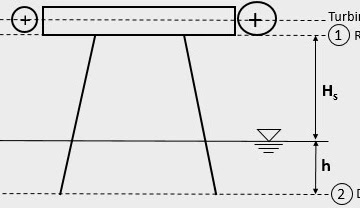
Applying Bernoulli's equation between runner exit (1-1) and draft tube outlet (2-2):
$$z_1+\frac{p_1}{\gamma}+\frac{v_1^2}{2g}=z_2+\frac{p_2}{\gamma}+\frac{v_2^2}{2g}+h_f$$
$$or, (H_s+h)+\frac{p_1}{\gamma}+\frac{v_1^2}{2g}=(\frac{p_{atm}}{\gamma}+h)+\frac{v_2^2}{2g}+h_f$$
$$or, \frac{p_1}{\gamma}=\frac{p_{atm}}{\gamma}-H_s-\frac{v_1^2-v_2^2}{2g}+h_f$$
$$or, \frac{p_1}{\gamma}=\frac{p_{atm}}{\gamma}-(H_s+\frac{v_1^2-v_2^2}{2g})+h_f \tag{1}$$
where,
$H_s$ = Static suction head
$\frac{v_1^2-v_2^2}{2g}$ = Dynamic suction head
$h_f = k\frac{v_1^2-v_2^2}{2g}$
$$or, \frac{p_1}{\gamma}=\frac{p_{atm}}{\gamma}-(H_s+\frac{v_1^2-v_2^2}{2g}-h_f )$$
$$or, \frac{p_1}{\gamma}=\frac{p_{atm}}{\gamma}-\left[H_s+(1-k)\frac{v_1^2-v_2^2}{2g}\right]\tag{2}$$
Now, draft tube efficiency can be written as:
$${\eta}_d=\frac{\text{Actual regain of pressure head}}{\text{Velocity head at entrance of draft tube}}$$
$$ =\frac{v_1^2-v_2^2}{2g}-h_f$$
$$=(1-k)\frac{v_1^2-v_2^2}{2g}$$

$$\therefore {\eta}_d=\frac{\frac{v_1^2-v_2^2}{2g}-h_f}{\frac{v_1^2}{2g}}$$
$$\therefore {\eta}_d=\frac{(1-k)\frac{v_1^2-v_2^2}{2g}}{\frac{v_1^2}{2g}}$$

From equation (2), it is clearly known that there exists a negative pressure at runner exit which is equal to $H_s+(1-k)\frac{v_1^2-v_2^2}{2g}$. From this, following two conclusions can be drawn:
  1. Due to the use of draft tube, the turbine will not lose head $H_s$ becasue of equal reduction in pressure head at runner exit.
  2. Due to use of draft tube of increasing cross-section, the pressure value at runner exit further reduced by $(1-k)\frac{v_1^2-v_2^2}{2g}$.

Purpose / Function of Draft Tube

  1. It helps to achieve the recovery of velocity head at runner outlet which otherwise would have gone to waste as an exit loss.
  2. It allows the turbine to be set at higher elevation without losing advantage of elevation difference.
  3. It serves as a passage for water from runner exit to tail pool.
Factors Affecting Selection of Foundation

Factors Affecting Selection of Foundation

Selection of particular type of building foundation is affected by various factors which are explained below:

1. Type of soil

Shallow foundation are preferred if the soil close to the surface has good bearing capacity. If the soil is not capable of supporting structural loads then deep foundation are required.

2. Load from Superstructure

If the structural loading is relatively small, shallow foundation may withstand load from superstructure. In case of high rise building with intense loading, deep foundations may become the only choice.

4. Settlement

If the foundation settlement is not within the allowable limit, then choice of foundation type may vary accordingly.

5. Property Line

Due to restriction of property line, a column may have to be placed at the edge of footing creating an eccentricity. In such case, a cantilever footing (or strap footing) should be provided.

6. Stress Overlap

If the spacing between column is very small, then the stress from independent footings might overlap and become larger than allowable limit. Thus, combined footing have to be preferred.

7. Local Building Codes & Regulations

Building codes and regulations set by local authorities dictate the minimum standards and requirements for foundation design and construction. Compliance with these regulations is essential to ensure the safety and stability of the building.

8. Environmental Factors

Environmental conditions, such as seismic activity, flooding etc need to be considered when selecting a foundation system. Regions prone to earthquakes, for example, may require specialized foundation designs to withstand the seismic forces.

9. Type of Structure in Neighborhood

High rise buildings may cause uplift of nearby building due to soil heaving. So, a pile foundation may be the solution to safely transfer load to the deep strata and not to harm the nearby structures if any.

10. Other Factors

  • Construction cost and time
  • Service life of structure
  • Safety Margin
  • Ground water table
  • Site topography
  • Depth of hard strata
Requirements of Earthquake Resistant Building Construction

Requirements of Earthquake Resistant Building Construction

An earthquake is a sudden and rapid shaking of Earth's surface caused due to the movement of tectonic plates floating on the molten rock below the surface of earth. It causes vibrations of structures and induce inertial forces on them. As a result structure may collapse resulting into loss of property and lives. Earthquakes do not kill people, vulnerable buildings do so. Hence, there is need of designing earthquake resistant buildings, especially in the earthquake prone areas. The earthquake resistance of buildings may be increased by taking some precautions and measures in site selections, building planning and building constructions which are explained below:

Improving Earthquake Resistance of Small Buildings

  • Avoid buildings in sloping grounds with different column heights.
  • Provide simple and symmetric geometry in plan.
Seismic resistant building plans
  • Avoid too many doors and windows close to each other.
  • Windows should be kept at same level.
  • In sloping roof with span greater than 6m, use trusses instead of rafters.
  • Building with four sided sloping roof is stronger than the one with two sided sloping, since gable walls collapse early.
  • Restrict the projections of chajja and balcony to maximum of 1m. For larger projections, use beams and columns.
  • Provide following RC bands:
    1. Plinth Band
    2. Lintel Band
    3. Sill Band
    4. Roof Band
    5. Gable Band
  • Offering retrofitting solutions to vulnerable structures ensures their resilience and safety is enhanced.

Improving Earthquake Resistance of High Rise Buildings

  • Provide shear walls evenly throughout the building.
  • Provide base isolation
  • Provide seismic dampers
  • Provide seismic gap in between neighbouring structures.
  • The reinforcement within structural elements should ensure adequate strength and ductility.
Concept of IEE/EIA & Its Importance in Project Development

Concept of IEE/EIA & Its Importance in Project Development

 Concept of IEE / EIA

The concept of IEE/EIA was first introduced in USA in 1970 AD under United States Environmental Law. This concept spread worldwide particularly after UN Earth Summit held in 1992 at Rio De Janeiro, Brazil. In the context of our country, government of Nepal introduced the National Environment Impact Assessment Guideline in 2050 BS. The Environment Protection Act 2053 and Environment Protection Regulation 2054 were then formulated. A new environment protection act was introduced by government of Nepal in 2076 BS. Such acts and guidelines provide a legal framework that requires developers to assess and mitigate the environmental impacts of any development project. IEE/EIA is a tool to identify and manage the effects of a development project to the environment. 

Initial Environmental Examination (IEE)

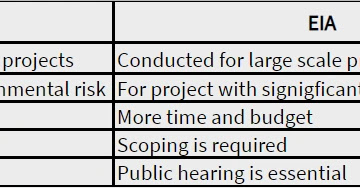
It is a preliminary environmental assessment for small projects with relatively low environmental risk. If IEE provides solutions to the identified environmental problems, then EIA is not necessary. If EIA becomes necessary, IEE serves as a valuable precursor to full EIA. The methodology involved in initial environmental examination (IEE) are as below:
  • Project description
  • Environmental screening
  • Preparation of TOR
  • Approval of TOR by concerned body
  • Conducting Environmental Assessment
  • Preparation of IEE Report
  • Submission of IEE Report
If the IEE report submitted is approved by concerned authority, the project is implimented. If it donot get approved, EIA is needed.

Environmental Impact Assessment (EIA)

It is the more extensive environmental assessment process for relatively larger project with potentially significant environmetal impacts. Its methodology includes:
  • Project description
  • Environmental screening
  • Preparation of TOR and Scoping
  • Approval of TOR and Scoping
  • Environmental Assessment
  • Preparation of draft EIA report
  • Disclosure of draft EIA report for comments and review
  • Submission of EIA report
If the EIA report submitted gets approved then the project is implimented otherwise, redesigning of project is necessary.

Principles of EIA

  1. Cost Effectiveness
  2. Transparency
  3. Certainity
  4. Participation
  5. Practicality

Difference between IEE and EIA

Difference between IEE and EIA

Importance of IEE / EIA

  • To identify the environmental impacts
  • To assess whether the impacts can be mitigated
  • To recommend the corrective and preventive mitigation measures
  • To examine the enviromental implications
  • To inform the decision makers and concerned parties about the environmental implication
  • To advise whether the development project should go ahead or not.